Every night billed.
Every request owned.
Every day closed.
A property management system and an operations desk on one spine. Bookings, check-in, folios and GST invoices — and a QR queue that puts one name and one clock on everything that breaks in between.
Independent hotels, hostels and resorts of 20–80 rooms, and the offices and sites that run on the same discipline. From ₹2,999 a month per property. Free for 45 days on the Pro plan, nothing held back inside it, and we do the setup.
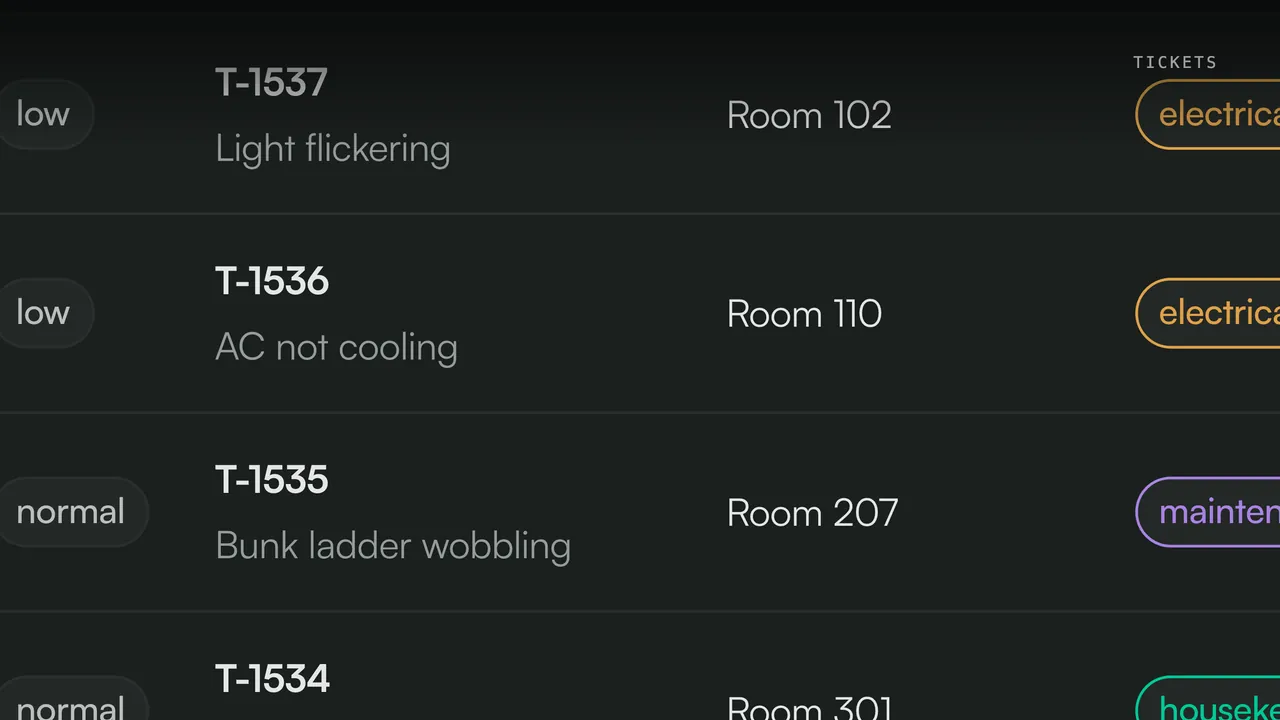
One request from the moment a guest raises it, and one stay from the desk to the bill.
01One ordinary Tuesday, twice
Nothing here is dramatic. That is the point.
The ordinary slippage of a single day at a small property. On the left, what a register, a spreadsheet and a WhatsApp group can tell you afterwards. On the right, the same seven moments on Nivasik.
“AC not cooling, 207” goes into a group of fourteen people. Three of them read it. None of them owns it.
Nobody can say whose job it was
It becomes a ticket with one name on it. A QR sticker in the room, or reception logging it at the desk — three ways in, one queue. The acknowledge and resolve targets come from the category, and the clock is on the record whether or not it is met.
Check it: raise one request in the demo. It has an owner, an acknowledge target and a resolve target before you close the screen.
A late checkout is agreed at the desk. It goes on a slip, and onto the bill if somebody remembers at six o’clock.
Revenue you already earned, leaking
The room nights post when the check-out screen opens — before anything is totalled — so the bill you show, the base a percentage discount comes off and the amount in the payment box are the same full number. The screen will not save a discount without a reason attached to it.
Check it: check one guest out. The room charge is already on the bill before you total it.
A geyser leaves the store for repair. Somebody writes it on a torn page. In October you find the page and it says geyser — 1.
A record anyone can tidy up later
Issue it into a room and it stops being stock and becomes a tracked thing — in store, installed, in repair, back, written off. The movement log is written by the database itself, not by the page, and there is no permission anywhere that allows editing or deleting a line of it.
Check it: issue one item into a room, then look for a way to delete the movement. There is not one.
The housekeeper who does the work does not read English. So the receptionist types everything, and you have bought software for one person.
One person using it is nobody using it
The whole interface switches to Hindi on one tap, on that person’s own phone, and back the same way. Your data is untouched by it: a guest’s name, a room number and an amount are never translated, because nothing in the language pack matches them.
Check it: switch the demo to Hindi. The sample guests keep their names.
Cash is in the drawer, UPI is on a phone, and what you spent is in a notebook. A good week and a bad week look identical until the month ends.
You cannot say what today made
One day book. What came in, split by method and by where it came from, against salary, maintenance, fuel, rent and stock going out — and what is actually left. Settlement from a company or an OTA is reported apart from the drawer, because it is not money in the drawer.
Check it: open the day book. Cash, UPI and card are separate lines, and the settlement rows are not in the drawer total.
You pay eight people. Attendance is a wall chart with half-days rounded, an advance from March is remembered in April, and the payslip is a WhatsApp message.
The loudest person looks the busiest
One square per person per day builds the month. A day of pay is the salary over the days in that month, never a fixed thirty, and a half day is half present and half absent. Paying books the net as an expense, because the advance already left when it was handed over.
Check it: open a payslip. The month it was computed for is frozen on the record.
One night nobody charged. The guest has gone. Nobody is going to look at that stay again, so it is simply money the property earned and did not collect.
Done, and invisible
A tile that appears only when it is not zero: the nights that were never billed. Two buttons, because a property has two answers — bill it at the real rate, or write it off with a reason, filed as a write-off and never as a discount, so a discount total stays a discount total.
Check it: the Command Center shows the tile only when the figure is above zero.
02The front desk
A booking becomes a room, a bill and an invoice — without anyone typing it twice.
The other half of the product, in the order a stay actually happens. Each step hands the next one the thing it needs, so nothing is entered again and nothing is remembered.
- BookedThe rack refuses a double booking
- Checked inID on file, folio opened
- ChargedNights, restaurant, extras
- SettledCash, UPI, card, transfer
- ClosedAudited, invoiced, filed
A washroom with nobody responsible for it is the same problem as a room.
Put the sticker on a pantry instead of a bedroom door and the whole product changes its vocabulary: Rooms become Spaces, Guests become Occupants, Hotel becomes Site. Across every screen, not a label on the front page. The queue, the clock, the owner on every job, the SLA targets per category, the asset register, the stock room and the day book do not change. The building is different. The work is not.
Check it: the industry pack is one setting. A property that runs a corporate back office keeps both, and adds the office categories on top.
03The only number on this site
What a clock on the queue actually did.
One measurement from the pilot, with everything it excludes stated. Nothing else on this page is a statistic, because nothing else has been measured yet.
Taken — cash, UPI, cardSpent — salary, stock, fuel, rent
Settlement from a company or an OTA is reported apart from the drawer, because it is not money in the drawer. Sample property.
04Every screen, and when you get it
Nothing is drip-fed after you sign.
Forty-three screens, in the seven groups the sidebar uses. Every plan opens on the Pro feature set for 45 days, and on day one your rooms, staff, rates and response targets are already loaded, because we do the setup.
43 screens in 7 groups. Every one of them is in the 45 free days.
Nothing here by that name.
Today1 screen
- Command Center
Requests4 screens
- Tickets
- Smart Intake
- SLA Engine
- Automations
Stays9 screens
- Front Desk
- Reservations
- Room Rack
- Guests
- Groups & Blocks
- Housekeeping Board
- Lost & Found
- Guest Messaging
- Police & Form C
Money9 screens
- Folios
- Payments
- Cashier
- POS & Outlets
- GST Invoices
- City Ledger
- Night Audit
- PMS Reports
- Revenue Insights
Property10 screens
- Rooms, Rates & QR
- Room Types
- Assets
- Preventive Maintenance
- Inventory
- Parking
- Vendors
- Expenses
- Booking Engine
- Channel Manager
Team6 screens
- Staff
- People & Pay
- Productivity
- Reputation
- AI Ops Brain
- Property ROI
Setup4 screens
- Settings
- Import Data
- Help & Docs
- Plan & Billing
2 marked Two of these need one step only you can take — the next section says which.
05What it does, and what it needs from you
Three things worth knowing before you buy.
Each of these works today, and each has one step that only you can take — an account or an agreement in your property’s own name. Better read here than found in month two.
Booking engine
A public booking page on your own address that quotes live from your rate calendar and takes a booking as “pay at the property”. No OTA commission on it. It quotes and holds rather than charging — taking a card needs a Razorpay, PayU or Cashfree gateway opened in your property’s own name.
Channel manager
Two-way iCal sync with Airbnb and Booking.com, a commission register, and a parity sheet that shows where your own price differs from theirs. Pushing rates into MMT, Goibibo or Agoda needs a signed connectivity agreement between you and each of them.
Guest messaging
Templates, a due list derived from the stays you actually have, one-tap WhatsApp, SMS and email links, and a log of what was sent to whom. Sending automatically needs WhatsApp Business API with Meta-approved templates, or DLT registration for SMS.
One more, and it is structural: each property is its own island, so there is no single screen that adds every property together yet. You switch between them.
06Your data
One property cannot read another’s rows. The database refuses, not the app.
Every property’s rows are scoped by the database itself. A session carrying property A’s token asking for property B’s rows gets nothing back — there is no application check to forget.
Never in the browser. The public key that ships in every page has zero table access; a guest scanning a QR code goes through a function that derives the property from the room, not from anything the browser sends.
AWS ap-southeast-1, encrypted in transit and at rest. Daily backups. The ID document a guest hands over sits in a private bucket, and every read of it mints a link that expires in two minutes.
Ask and we hand you your data, then delete it from our systems. No lock-in period, no exit fee, no notice period. Offboarding actually deletes — including the scanned IDs, which is the part most people forget.
07Hotel software pricing in India
One flat price per property.
No per-guest fees, no usage meters, no setup fee. All-inclusive rupee pricing. Cancel any time.
Free for 45 days
The whole Pro feature set from day one, every unit included, whatever you settle on afterwards. No card, because there is no in-product billing. We invoice you, and only once you decide to stay.
Core
₹2,999
per property / month · up to 40 units
- Tickets, from request to resolved
- Rooms, dorm beds & printable QR codes
- Reception intake at the desk
- SLA targets per category
- Staff, roles & per-person permissions
- Reports and the Android alert app
Pro Your 45 free days run here
₹4,999
per property / month · up to 80 units
- Everything in Core
- The PMS: reservations, room rack, rates, front desk
- Folios, payments, GST invoices & night audit
- Housekeeping, guests & lost and found
- Preventive maintenance, expenses, vendors & inventory
- Police register & Form C for foreign nationals
- AI daily digest, computed from your tickets
Group
₹2,499
per property / month · from 3 properties
- Everything in Pro, at every property
- POS & outlets, cashier shifts and the city ledger
- Groups & blocks, the booking page and channel sync
- One invoice for the whole group
- Direct line to the founder
Founding cohort: the first 20 properties
Core at ₹1,999 a month, locked for 24 months, in exchange for an honest published review once you have used it for a month. Honest includes critical.
POS, tables and the kitchen queue
A restaurant, café or bar: a QR on every table, a kitchen screen with a clock on it, and the outlet’s own takings and costs kept apart from the property’s. Sold separately, on any plan — and on its own to a restaurant that is not a hotel.
Full module-by-module comparison on the pricing page.
08Hotel PMS questions
The things owners actually ask.
Where does the money come back?
Four places we can point at in the product. Unbilled nights: the system lists every night nobody charged and lets you bill it or write it off with a reason, so revenue you already earned stops leaking. Direct bookings: your own booking page quotes from your rate calendar, and a direct booking carries no OTA commission. Giveaways: complimentary items are recorded at their real value with a reason, so “what did we give away last month” is a number instead of a feeling. And staff: the productivity screen counts real work per person across tickets, rooms cleaned, check-ins and orders, which is how you find out whether you are staffed for the season you are actually in.
How much does hotel management software cost in India?
One flat price per property per month. No per-guest fees, no usage meters, no setup fee. Core is ₹2,999 per property per month for up to 40 units, Pro is ₹4,999 for up to 80 units, and from three properties the group rate is ₹2,499 per property. Every plan starts with 45 days free on the Pro feature set, and we invoice you only if you stay.
Will my staff actually use it?
They open one page on the phone they already have. No app store, no training day. The receptionist logs a walk-in complaint in about fifteen seconds, housekeeping sees their own jobs and not your numbers, and maintenance on the Android app gets a full-screen alert for anything urgent, loud enough to be heard through a silent phone at 2am. The clock on each request is what keeps it honest: if something is ignored, that is visible to you rather than to nobody.
Do guests need to install anything?
No, and that is the point. They scan the QR sticker in the room with the normal camera, tap a category, and they are done. No app, no login, no phone number. The request lands on the right person’s phone with a response target already running, and the guest gets an answer instead of walking down to reception.
Is it a PMS? Does it replace mine?
Yes, it is a full property management system. Reservations and a room rack that refuses double bookings, rooms and rates with a price for any night, check-in and check-out, folios, payments, GST invoices, a housekeeping board, and a night audit that can close the day by itself. It also carries the operations half that most PMS products do not have: guest requests with an owner and a clock, staff permissions, assets and preventive maintenance, expenses against a vendor. If you already have a PMS you trust, keep it and run Nivasik alongside for requests, housekeeping and maintenance.
Can I run more than one property on it?
Yes. Each property gets its own address, its own staff and its own data, isolated from every other property at the database level, and from three properties the group rate applies with one invoice for the whole group. What does not exist yet is a single screen that adds every property together; you switch between them today. We would rather say that than let you find it out in month two.
Does it work for a hostel, a resort or an office?
All three, and the words on screen change with the building. A hostel gets dorm beds with their own QR codes and the high-turnover front desk that goes with them. A resort gets a spread-out property with an asset register per AC, geyser and lift, and maintenance jobs raised before something breaks. An office gets QR codes on washrooms, pantries, meeting rooms and parking, its own request categories, a stock register that covers both the tea and coffee you count and the heater you follow, and a vehicle register with plate, owner and phone.
How long does setup take, and who does it?
About a day, and we do it for you. We load your rooms or office spaces and your staff, set your rate types and prices, set your response targets per category, and send you the QR codes to print. If your room list is already in Excel, we import it. You get the whole product on day one, not a starter tier that unlocks later.
Who owns the data, and where does it live?
You do. It sits on managed Postgres in Singapore (AWS ap-southeast-1), encrypted in transit and at rest, with every property’s rows isolated from every other property’s by the database itself rather than by the app. Passwords are checked on our server, never in the browser, and the database refuses a card number typed into a payment reference. Ask and we hand you your data, then delete it from our systems: no lock-in period, no exit fee, no notice period.
09See it in your own building
Twenty minutes, on your rooms.
We load your rooms or floors, then walk a booking through check-in to a GST invoice — and one guest request from QR scan to resolved — on your phone, while you watch.
Prefer to talk now? WhatsApp us or email support@nivasik.com
Run it from the phone in your pocket
The Android app opens from the device instead of waiting on the network, still shows the last data it received when the wifi drops, and can ring a critical alert full-screen through a silent phone. On iPhone, open your property’s link in Safari and tap Share → Add to Home Screen; it runs from the home screen like any other app.
APK · 6.3 MB · v2.1.3 · Android 6.0 and later